
The short-term rental market has entered a new phase in which operational maturity and financial resilience are essential to earning the trust of guests and owners. Unbridled supply growth and easy money have given way to a climate where margins are now under siege from rising labor costs, insurance premiums, and localized regulatory shifts.
In this landscape, artificial intelligence has quickly transitioned from a fascinating novelty into an operational necessity. Everyone has access to basic text generators, but enterprise-class operators must treat AI as a critical infrastructure layer.
Separating the signal from the noise means knowing which tools protect your margins and which ones merely exhaust your team. Those who can tell the difference can gain a real edge in a rapidly evolving market.
The most valuable AI applications today are those that anchor themselves into your existing data structures to eliminate repetitive workflows.
In a contact center, capturing and nurturing every lead is essential to building a predictable revenue stream. Advanced tools like TrackPulse use AI to help agents reduce call wrap-up times and ensure accurate lead creation. Real-time speech recognition handles the initial routing and basic context gathering so your team doesn’t miss details that are critical to a flawless guest experience and the repeat business that follows.
AI is only as good as the data it draws from — your data. Automation tied directly into an integrated system like TrackPMS provides real value. When property details, pricing, and guest communications flow from a single source of truth, automated triggers can dispatch maintenance vendors or flag reservation changes instantly and accurately without human error. Clean data structures power the sophisticated workflows professional operators depend on.
Anyone can spend precious capital on tools that create more complexity rather than resolving high-stakes problems. The ability to discern one from the other is increasingly critical.
AI-written blogs and automated property descriptions are sucking the uniqueness out of vacation rental content at the same time they’re practically announcing themselves as AI. Guests and owners can already spot generic, uninspired copy, and they’re getting better at it by the day. Relying on basic generative models to build your brand voice won’t differentiate your portfolio. It only dilutes your authenticity.
That isn’t to say that you shouldn’t use these tools to save you time and/or increase your output. But you must do it the right way, or they could do more harm than good.
The key is to train tools like ChatGPT, Gemini, and Claude to sound a) more human, and b) more like your brand voice. By “coaching up” the learning language models (LLMs) through extensive and specific guidance, along with appropriate prompting, you can generate drafts that don’t scream AI yet are grammatically perfect. There should always be a human in the loop (HITL, see below) to gut-check what an LLM produces and tweak the instructions accordingly. Check back soon for a comprehensive guide on instructions and prompting for hospitality companies.
Investing in flashy, standalone AI gadgets that stand apart from your core stack creates a fundamental disconnect. If an AI tool requires a separate login, isolated billing, and a disconnected database, it introduces invisible risk. The time your team spends jumping between browsers and manually reconciling data silos can quickly erase whatever efficiency gains you were trying to create.
That’s not to say there aren’t good third-party solutions that will play very nicely with your stack. But it pays to understand the workflow of such tools at a granular level so you can see how they’ll impact daily operations.
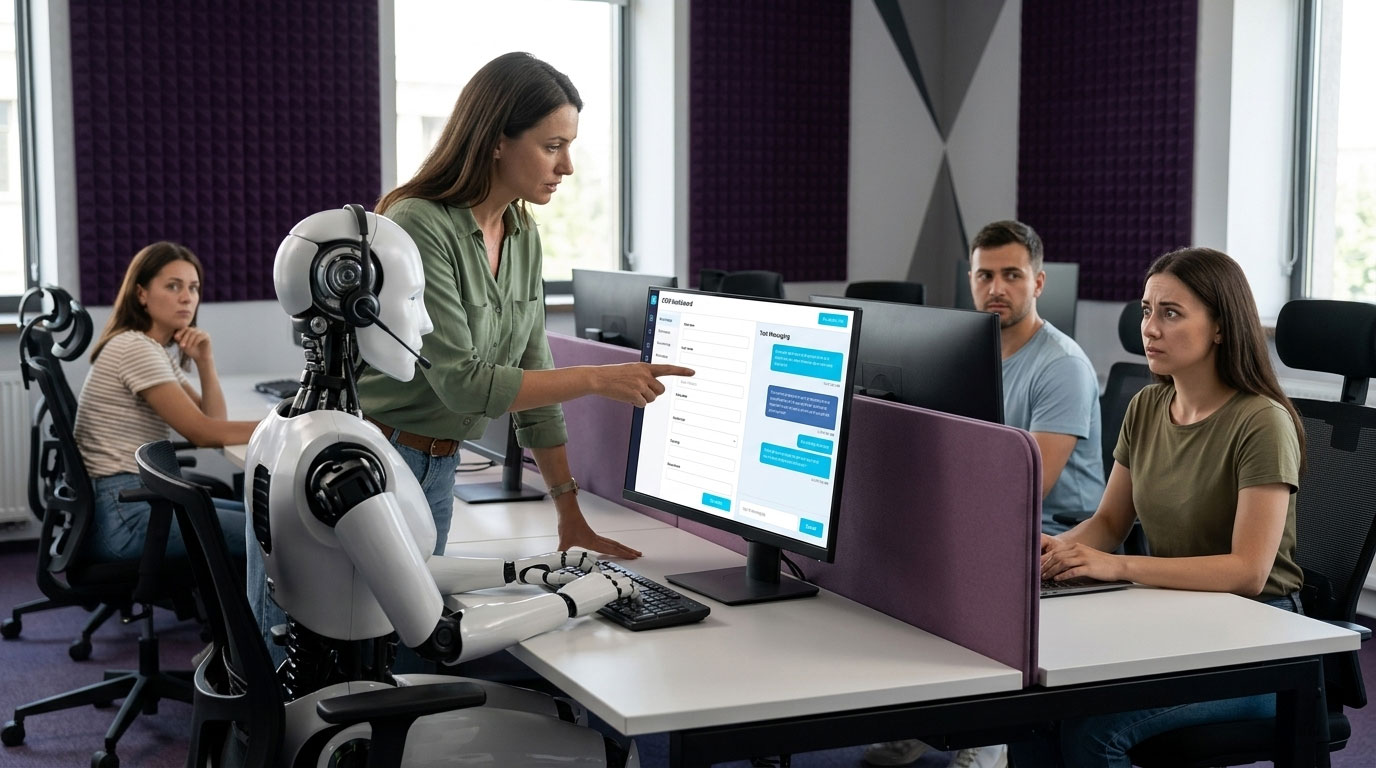
If generative technology is the present, autonomous execution is the future. And it’s going to change almost everything. Again. That might sound scary to anyone who’s seen Terminator, but the sooner you can make peace with the reality of agentic AI, the better your chances of taking a huge leap forward.
We already are transitioning from models that create content to agentic models that execute complex tasks. Future workflows will see AI agents negotiating rebooking options directly with guests during maintenance emergencies, dynamically adjusting pricing rules based on hyper-local event compression, and managing multi-channel distribution updates in real-time.
Chances are, you already have some triggers and automations set up, such as automated and tokenized replies to bookings or an automated message to housekeeping upon registering a check-out. Agentic AI will work similarly but with more sophisticated inputs and outputs.
While traditional triggers require a strict, predictable chain of events, agentic systems use your clean, unified data to solve multi-step problems independently. Think of it as moving from a simple relay switch to an intelligent team member. Instead of just sending a fixed alert, an autonomous agent can evaluate a guest request, cross-reference your local compliance rules, adjust dynamic pricing rules, and deploy a vendor without requiring manual oversight. It handles the administrative busywork so your team can focus entirely on high-value stakeholder relationships.
As autonomous agents take on more responsibilities, the risk of a “black box” error increases. The answer, at least for now, is Human-in-the-Loop (HITL) architecture. Enterprise-caliber systems will leverage AI to execute rote tasks while maintaining strict guardrails, keeping human operators in control to protect brand standards and ensure complete legal and financial compliance.
This is where the “gut check” we mentioned earlier comes in. One way to think about it is that agentic AI will be like a nerdy, data-loving, hyper-efficient new employee who never goes home or takes a lunch break. Just as you would want to review the work of any new employee before a customer or owner sees it, you need to do the same for AI-generated content and AI agents. Remember, the buck still stops with you.
Deploying automation is useless if you can’t verify its ROI. Professionalized management still requires measurable outcomes that answer the question, “Is this thing working?”
To know if AI is working, focus on concrete operational indicators such as:
Saving ten hours a week per employee only drives profitability if that time is usefully repurposed. Clean, structured tech infrastructure gives your team the breathing room to focus on high-value initiatives.
Instead of chasing spreadsheets, your staff can dedicate themselves to building deeper relationships with property owners, optimizing direct booking strategies through TrackEcommerce, and delivering the distinct professional sheen that keeps guests returning season after season.